
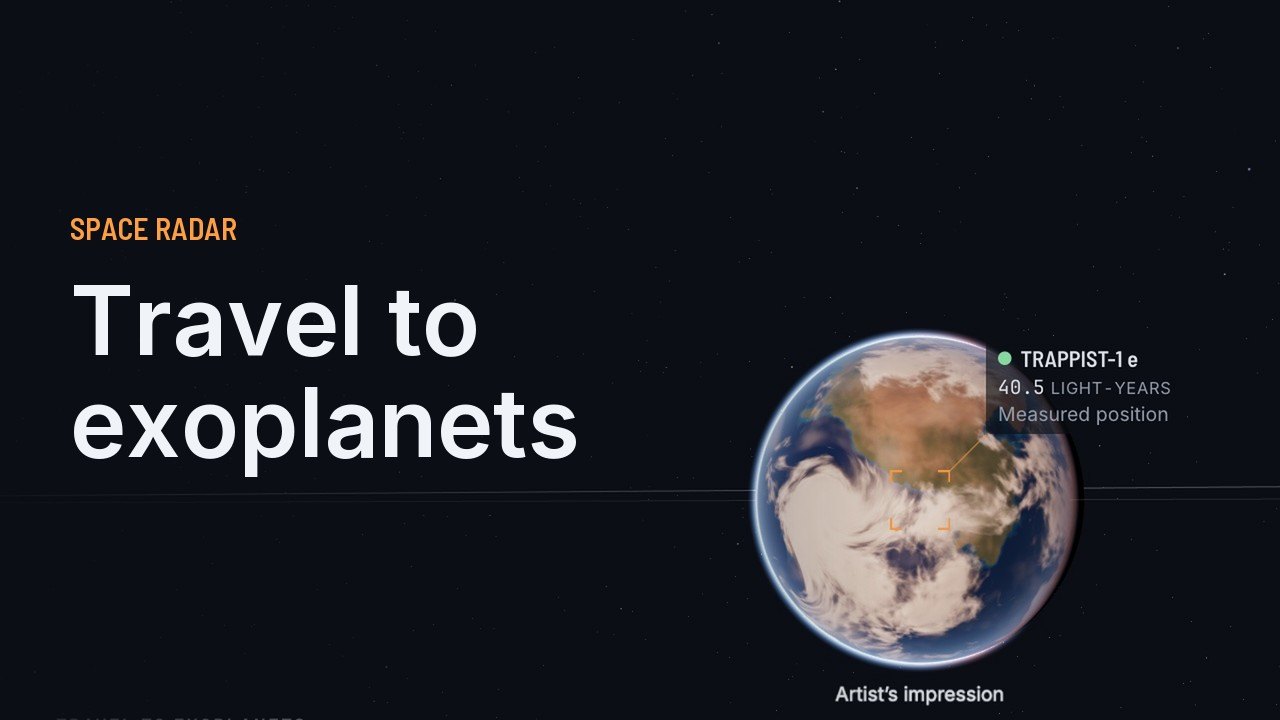
Plays from YouTube (youtube-nocookie.com) when you press play. Nothing loads from YouTube before that.
Travel to exoplanets: TRAPPIST-1, then on to Andromeda, in live 3D
Fly from the Sun to Proxima b, round six worlds of TRAPPIST-1, then out through the Milky Way to Andromeda, on a 3D map where every position is computed.
Chapters 17
- 0:00Travel to exoplanets: Planets around other stars0:32
- 0:32The nearest one0:20
- 0:52Seven worlds round a small red star0:20
- 1:12TRAPPIST-1 e0:23
- 1:35TRAPPIST-1 b0:22
- 1:57TRAPPIST-1 c0:16
- 2:13TRAPPIST-1 d0:15
- 2:28TRAPPIST-1 f0:17
- 2:45TRAPPIST-1 h0:19
- 3:04All of it inside Mercury's orbit0:25
- 3:29To the edge of what we know: The Sun, from one light-year0:24
- 3:53Proxima Centauri0:19
- 4:12Sirius0:18
- 4:30The Pleiades0:19
- 4:49The centre of the galaxy0:24
- 5:13The Milky Way0:19
- 5:32Andromeda0:42
Two of Space Radar's narrated trips, joined into one film: Travel to exoplanets, from the Sun to Proxima b and round six worlds of TRAPPIST-1, then To the edge of what we know, out past Sirius and the Pleiades to the centre of the Milky Way and Andromeda.
Every star and planet is where the published catalogues put it, computed for 10 October 2026, 18:00 UTC. Nobody has photographed these planets, so every generated planet surface is labelled "Artist's impression" on screen.
Transcript
50 lines · read along
The narration as written for the film, from its caption file; the same words are burned into the picture. The voice reading it is synthetic.
0:00 Travel to exoplanets: Planets around other stars
Planets around other stars. More than six thousand planets around other stars, in the copy of NASA's catalogue this map carries, each drawn as a mark at its star. Most were found by the dip in a star's light as a planet crosses in front of it, the rest mostly by the wobble a planet gives its star.
0:32 The nearest one
The nearest one. Proxima b goes round the nearest star to the Sun, four light-years away, once every eleven days. Nobody has seen it: it was found by the wobble it gives its star.
0:52 Seven worlds round a small red star
Seven worlds round a small red star. TRAPPIST-1 is a cool red star forty light-years away, a little bigger than Jupiter. Seven planets about the size of the Earth go round it, and all seven were found as they crossed in front of it.
1:12 TRAPPIST-1 e
TRAPPIST-1 e. A year here lasts six days. It is nine tenths as wide as the Earth and seven tenths as heavy, and at its closest its neighbour d would look as wide in its sky as the Moon is in ours.
1:35 TRAPPIST-1 b
TRAPPIST-1 b. The innermost, 1.7 million kilometres from its star, over thirty times closer than Mercury is to the Sun. Its year is a day and a half, and it is a tenth wider than the Earth.
1:57 TRAPPIST-1 c
TRAPPIST-1 c. The second out, round its star in just under two and a half days. Like b it is a little wider than the Earth and about a third heavier.
2:13 TRAPPIST-1 d
TRAPPIST-1 d. Four days a year, and the smallest but one: four fifths of the Earth's width and less than two fifths of its mass.
2:28 TRAPPIST-1 f
TRAPPIST-1 f. Nine days a year, and the nearest of the seven to the Earth's own size and mass, a few per cent over on both.
2:45 TRAPPIST-1 h
TRAPPIST-1 h. The outermost and the smallest, three quarters of the Earth's width. A year here is nineteen days, and b goes round twelve times in one of them.
3:04 All of it inside Mercury's orbit
All of it inside Mercury's orbit. The dashed ring is the size of Mercury's orbit round our Sun, drawn here for scale. It is six times wider than the orbit of h: every one of these worlds is closer to its star than Mercury is to ours.
3:29 To the edge of what we know: The Sun, from one light-year
The Sun, from one light-year. From here the whole Solar System is smaller than a pixel. Light from the Sun takes a year to reach this spot; Voyager 1, the fastest thing we have sent out of the Solar System, would take about eighteen thousand.
3:53 Proxima Centauri
Proxima Centauri. The nearest star to the Sun, a dim red one an eighth of the Sun's mass. It has at least one planet. Every star you can see with your eyes at night is farther away than this one.
4:12 Sirius
Sirius. The brightest star in our sky, eight and a half light-years out and twenty-five times as bright as the Sun. The light reaching your eye tonight left it eight and a half years ago.
4:30 The Pleiades
The Pleiades. Over a thousand young stars, a hundred million years old, about four hundred and twenty-five light-years away. Their light left when Shakespeare was alive.
4:49 The centre of the galaxy
The centre of the galaxy. Twenty-seven thousand light-years from home, a black hole of four million Suns that the whole Milky Way turns around. The disc, bar and arms drawn around you are a model built from measurements; the stars are the measured part.
5:13 The Milky Way
The Milky Way. Our galaxy, about ninety thousand light-years across, seen from sixty thousand light-years above its disc, a view nobody has had. The shape is an illustration of what has been measured.
5:32 Andromeda
Andromeda. The nearest big galaxy, two and a half million light-years away and coming our way. Its light left when the first humans were learning to use tools.
How it was made
- The narration is a synthetic voice (Kokoro-82M, bf_emma); the words are ours.
- Positions are computed for 10 October 2026, 18:00 UTC.
- Nobody has photographed these planets: every generated planet surface is labelled "Artist's impression" on screen.
- The Milky Way's shape is an illustration of what has been measured.
Credits
- Stars: the HYG star database. Planets of other stars: NASA Exoplanet Archive. Clusters and galaxies: OpenNGC.
- Positions of the Sun and planets: astronomy-engine (MIT).
- Planet maps: Solar System Scope (CC BY 4.0). The Milky Way: NASA/Goddard Space Flight Center Scientific Visualization Studio.
- Narration: a synthetic voice, Kokoro-82M (bf_emma), Apache-2.0.
- Music: Fake Vega, Calabi-Yau, Edge of the Sky and Above the Clouds by John Bartmann, CC0.
Go further
- Trip on the mapTravel to exoplanetsThe first half of the film as a trip you fly yourself, on the live map
- Trip on the mapTo the edge of what we knowThe second half, from one light-year out to Andromeda
- JournalStars with no distance, 4 383 pulsars and the farthest galaxy
- JournalA virtual space tour that begins with a family photo
- The mapSpace Radar, the live 3D mapFree, in the browser, open source
Watch next
From the Moon to Voyager 1: the Solar System in a live 3D map
Eight places we have landed on the Moon, then Io, Europa, Saturn, Enceladus, Triton, Pluto and out to Voyager 1, on a 3D map where every position is computed.