
Plays from YouTube (youtube-nocookie.com) when you press play. Nothing loads from YouTube before that.
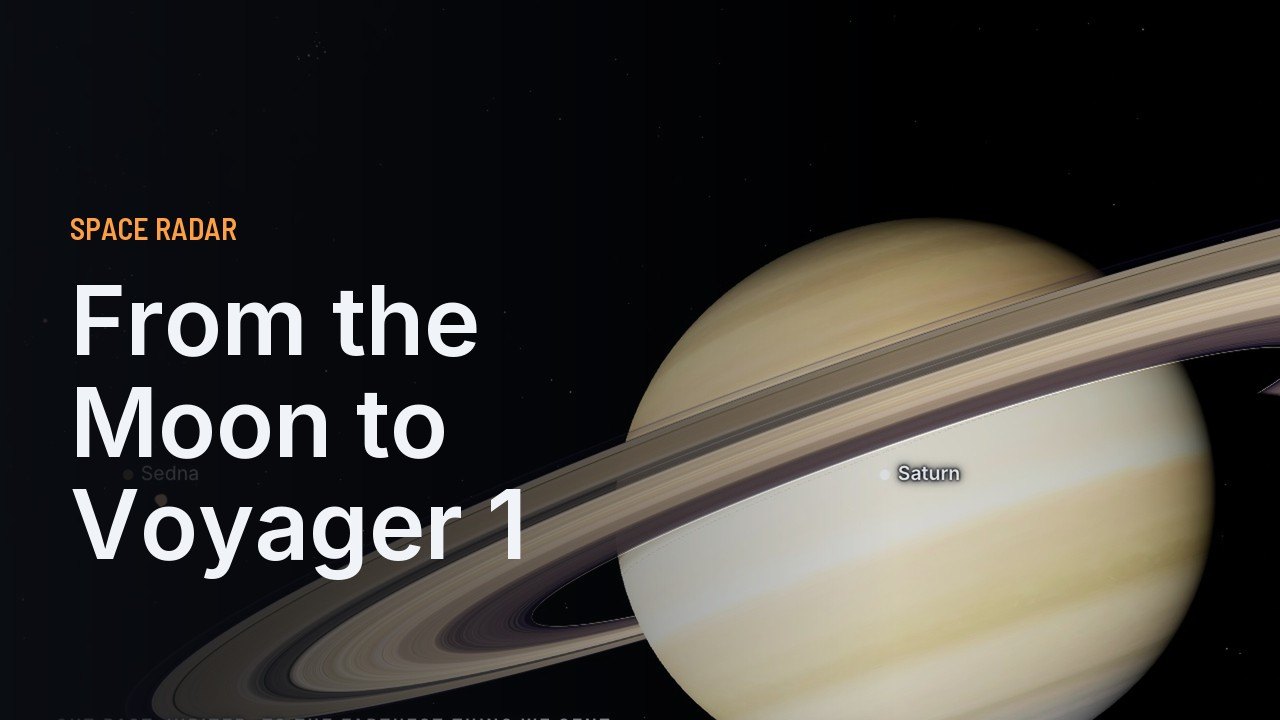
From the Moon to Voyager 1: the Solar System in a live 3D map
Eight places we have landed on the Moon, then Io, Europa, Saturn, Enceladus, Triton, Pluto and out to Voyager 1, on a 3D map where every position is computed.
Chapters 15
- 0:00Where we have landed on the Moon: The first soft landing anyone can find0:38
- 0:38The first people0:21
- 0:59A visit to an older robot0:20
- 1:19Seventy-five hours, then a long quiet0:24
- 1:43The side that never faces us0:25
- 2:08Near the south pole0:26
- 2:34An eclipse, seen from the Moon0:25
- 2:59Twenty-eight landings, nineteen on this map0:29
- 3:28Out past Jupiter, to the farthest thing we sent: Io, the moon Jupiter never lets rest0:26
- 3:54Europa, and the two ships on their way0:30
- 4:24Saturn, and a ring ten metres thick0:24
- 4:48Enceladus, spraying its ocean into space0:31
- 5:19Triton, going the wrong way round0:30
- 5:49Pluto and Charon, going round each other0:27
- 6:16Voyager 1, and everything behind it0:43
Two of Space Radar's narrated trips, joined into one film: Where we have landed on the Moon, eight landing sites from the first soft landing to the south pole, then Out past Jupiter, to the farthest thing we sent, from Io to Pluto and out to Voyager 1.
Every position is computed, for 10 October 2026, 18:00 UTC. The landers and spacecraft are 3D models placed at their measured positions and drawn far larger than life.
Transcript
53 lines · read along
The narration as written for the film, from its caption file; the same words are burned into the picture. The voice reading it is synthetic.
0:00 Where we have landed on the Moon: The first soft landing anyone can find
The first soft landing anyone can find. It was not the first. The Soviet Luna 9 landed softly four months earlier, on 3 February 1966, but NASA's table says the place published for it is probably at least 10 km out, direction unknown. Surveyor 1 shut off its engines 3.4 m up and dropped the rest of the way.
0:38 The first people
The first people. Neil Armstrong and Buzz Aldrin stayed 21 hours and 36 minutes. Their whole walk covered about 250 metres, and neither went more than about 100 m from the lander. Michael Collins waited for them in orbit.
0:59 A visit to an older robot
A visit to an older robot. On their second walk they went over to Surveyor 3 and brought about 10 kg of it home to study, its TV camera included. That camera is on show at the Smithsonian's National Air and Space Museum in Washington.
1:19 Seventy-five hours, then a long quiet
Seventy-five hours, then a long quiet. Gene Cernan and Harrison Schmitt, the first scientist to walk on the Moon, stayed 75 hours and covered 30 km with their rover. After them robots landed three more times, and then nothing landed softly on the Moon for 37 years.
1:43 The side that never faces us
The side that never faces us. From here the Earth is always below the horizon, so the Moon itself blocks any radio link home. China first put a relay satellite, Queqiao, out beyond the Moon, and the lander spoke to Earth through it. Its rover, Yutu 2, was still driving four years later.
2:08 Near the south pole
Near the south pole. India's first try, Chandrayaan-2, carried a lander also called Vikram, and it crashed in September 2019 about 110 km from here. This one was built to work for one lunar day, about 14 Earth days, and was put to sleep on 4 September 2023.
2:34 An eclipse, seen from the Moon
An eclipse, seen from the Moon. It carried ten NASA instruments. On 14 March 2025 it watched the Earth pass in front of the Sun, a total eclipse seen from the Moon. Two days later it filmed the sunset, looking for a glow over the horizon that Gene Cernan saw on Apollo 17.
2:59 Twenty-eight landings, nineteen on this map
Twenty-eight landings, nineteen on this map. NASA's table of what lies on the Moon, last updated in August 2025, lists 28 landings, six of them with people aboard. This map marks 19 of them, two by where their rovers stopped. Luna 9, the first of all, is not one: nobody knows exactly where it is.
3:28 Out past Jupiter, to the farthest thing we sent: Io, the moon Jupiter never lets rest
Io, the moon Jupiter never lets rest. Io goes round Jupiter every 42 hours, pulled one way by the planet and the other by two moons further out, in time with it. All that kneading has to go somewhere, and it comes out of hundreds of volcanoes.
3:54 Europa, and the two ships on their way
Europa, and the two ships on their way. Under that ice is twice as much water as every ocean on Earth put together. Europa Clipper reaches Jupiter in April 2030 to fly past here 49 times and ask whether anything could live down there; Europe's JUICE arrives in 2031 and ends up circling Ganymede.
4:24 Saturn, and a ring ten metres thick
Saturn, and a ring ten metres thick. The rings reach eighty thousand kilometres out from the equator and in places are ten metres from top to bottom. They are almost all water ice. Cassini circled here for thirteen years and finished by flying into the planet in September 2017.
4:48 Enceladus, spraying its ocean into space
Enceladus, spraying its ocean into space. Cassini found the jets in 2005, coming off the south pole at four hundred metres a second, and flew straight through them. They carry water, salt, silica and more organic material than anyone expected, and they have not stopped: the dust keeps one of Saturn's outer rings supplied.
5:19 Triton, going the wrong way round
Triton, going the wrong way round. One spacecraft has ever visited Neptune: Voyager 2, on 25 August 1989. Five hours after passing the planet it flew by Triton, forty thousand kilometres up, and found a surface at minus 235 degrees with geysers going off on it.
5:49 Pluto and Charon, going round each other
Pluto and Charon, going round each other. New Horizons crossed this pair on 14 July 2015, nine and a half years out from Earth. It found mountains of water ice, and beside them a plain of nitrogen ice that is still slowly turning over. Sending the pictures home took until October 2016.
6:16 Voyager 1, and everything behind it
Voyager 1, and everything behind it. It passed Jupiter in March 1979 and Saturn in November 1980, and it has been leaving ever since, more than 170 times the Earth's distance from the Sun. In 1990 it turned round and photographed the planets it had left. Earth came out 0.12 of a pixel wide.
How it was made
- The narration is a synthetic voice (Kokoro-82M, bf_emma); the words are ours.
- Positions are computed for 10 October 2026, 18:00 UTC.
- The landers and spacecraft are 3D models placed at their measured positions, drawn far larger than life.
Credits
- Positions of the Sun, the Moon and the planets: astronomy-engine (MIT). Voyager 1: NASA/JPL Horizons.
- The Moon: Lunar Reconnaissance Orbiter WAC mosaic, NASA/GSFC/Arizona State University; relief: LOLA Science Team, NASA/GSFC.
- Maps of Io, Europa, Triton, Pluto and Charon: USGS Astrogeology, NASA/JPL-Caltech, NASA/JHUAPL/SwRI. Enceladus: NASA/JPL-Caltech/Space Science Institute/Lunar and Planetary Institute.
- Planet maps: Solar System Scope (CC BY 4.0). The Milky Way: NASA/Goddard Space Flight Center Scientific Visualization Studio. 3D models: NASA 3D Resources.
- Narration: a synthetic voice, Kokoro-82M (bf_emma), Apache-2.0.
- Music: Above the Clouds, Calabi-Yau and Edge of the Sky by John Bartmann, CC0.
Go further
- Trip on the mapWhere we have landed on the MoonThe first half of the film as a trip you fly yourself, on the live map
- Trip on the mapOut past Jupiter, to the farthest thing we sentThe second half, from Io to Voyager 1
- JournalWhere Is Voyager 1 Now? The Farthest Things We Threw
- JournalNew Horizons at Pluto: When Was Closest Approach, and How Close?
- JournalA virtual space tour that begins with a family photo
- The mapSpace Radar, the live 3D mapFree, in the browser, open source
Watch next
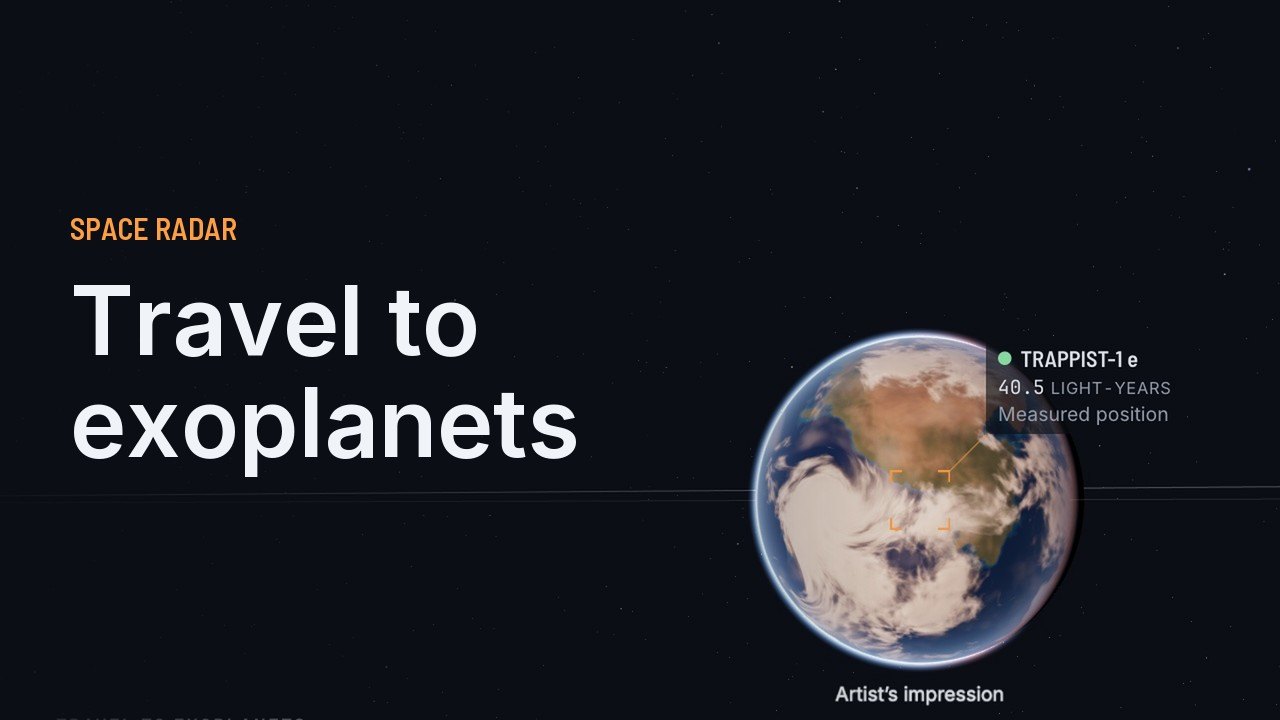
Travel to exoplanets: TRAPPIST-1, then on to Andromeda, in live 3D
Fly from the Sun to Proxima b, round six worlds of TRAPPIST-1, then out through the Milky Way to Andromeda, on a 3D map where every position is computed.